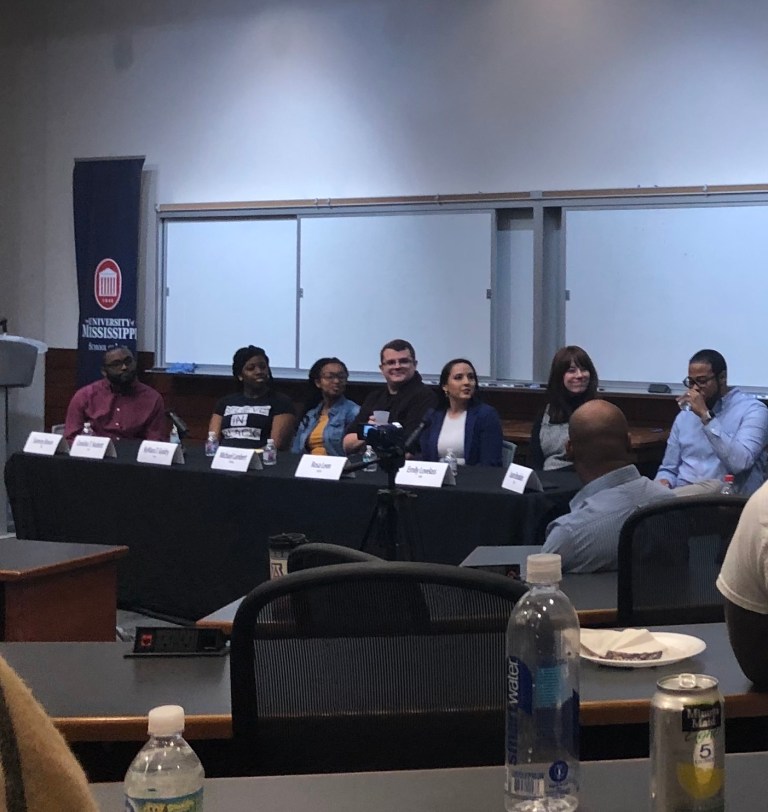
The University of Mississippi School of Law held a Dr. Martin Luther King Jr. commemoration panel as part of its Black History Month series to talk about the future of race relations while remembering the work of King.
A panel of seven students tackled questions about King and what it means for people going forward specifically in the South with the facilitation of Ethel Young Scurlock.
“There is the belief that Mississippi will always be the way it is,” Student Bar Association member Sammy Brown said. “Probably the greatest threat is the nagging doubt that there’s no point.”
Here in Mississippi, many people call on tradition as a way to perpetuate acts that may be perceived as racially. For example, students can still call on tradition in order to support the reinstatement of Colonel Rebel as the mascot even though it may be offensive to different people.
“Sometimes I don’t feel safe on Ole Miss’s campus,” Rosa Leon, a member of the Latino or Latina Law Student Association or LaLSA, said. “I am here, but sometimes I don’t want to be.”
Yet, Leon states that she feels like the university can change through a cycle of listening and speaking to each other. These conversations built on the willingness to listen and contribute that are needed to have to create change are often filled with tension.
“Nonviolent direct action seeks to create such a crisis and foster such a tension that a community which has constantly refused to negotiate is forced to confront the issue,” King said in his Letter from a Birmingham Jail.
Even when King aimed to create tension, he still believed in making sure that all people have dignity. He would listen to people who disagreed with him from both sides, people that disagreed with what he was doing because they didn’t want things to change, and people that disagreed with what he was doing because they believed in fighting for change in different ways.
“Dr. King shows us what tension looks like and shows us what it means to have meaningful dialogue,” Scurlock said.
This tension is crucial to dealing with race relations even though it can create uncomfortable situations.
“It’s time to get a little uncomfortable,” Student Bar Association member Conisha T. Hackett said. “We find ways to appease people, but I’m going to get uncomfortable for change to occur.”
Yet the panel didn’t only mention change for race relations but spanned across many different subjects. King did not only fight for civil rights, but he also stood up against poverty and war. Similarly, the panel discussions spanned across various topics including LGBTQ and women’s rights and political issues of today such as the Flint, Michigan water crisis.
Michael Lambert stated that he was going to get more uncomfortable by expecting more out of people when they wanted to be part of an alliance. When he refers to an alliance, the panel agreed that it included a group of people that were willing to educate themselves on the issues facing that group, understand what is going on and speak up even in the face of risk.
Lambert is a member of OUTlaw. OUTlaw is an organization that supports LGBTQ+ rights.
Attendee Akeena Edwards said that for people in attendance at the event race relations start with understanding and then hopefully will result in an alliance. She hopes that people will take the information from the event and talk about it so that the information will continue to spread.
The event drew students from the law school, the University of Mississippi and a field trip group of elementary school kids from Magnolia Montessori School. This event was just one of many in the Black History Month series. Other events planned throughout the month of February can be found on the Center for Inclusion and Cross-Cultural Engagement website.
 Ellie's Blog